Generative AI · RAG · 0→1 Product Development · Conversational UX Designing a RAG-Powered Customer Intelligence Product
Designing and launching a retrieval-augmented generation (RAG) product that helped business teams investigate customer feedback, identify patterns and use customer evidence to inform decisions. I designed the product UX flow for how AI-generated insights could be verified and trusted before stakeholders used them to make decisions.
The problem
A global ecommerce company had valuable customer-feedback data, but employees across different departments lacked an accessible way to explore it.
Customer support, digital product, merchandising, engineering and brand teams needed to understand recurring customer problems and identify patterns relevant to their work.
The challenge was not simply making the data searchable.
The product needed to help users ask useful questions, understand the answers and trust the information being presented.
With a RAG-based experience, the reliability of retrieved information and how supporting evidence appeared in the interface were central product and UX considerations.
What I owned
I led product discovery, definition, user flows, product UX design and cross-functional delivery through launch. My focus included designing conversational user journeys, presenting aggregated customer insights and making the underlying evidence accessible to stakeholders.
My work included understanding stakeholder needs, designing the conversational user experience, shaping how information was presented and collaborating with technical teams on the RAG-powered product.
I worked with technical teams to connect the RAG-based retrieval and processing capabilities with an understandable, trustworthy user experience.
Key product decisions
1. Design around business questions
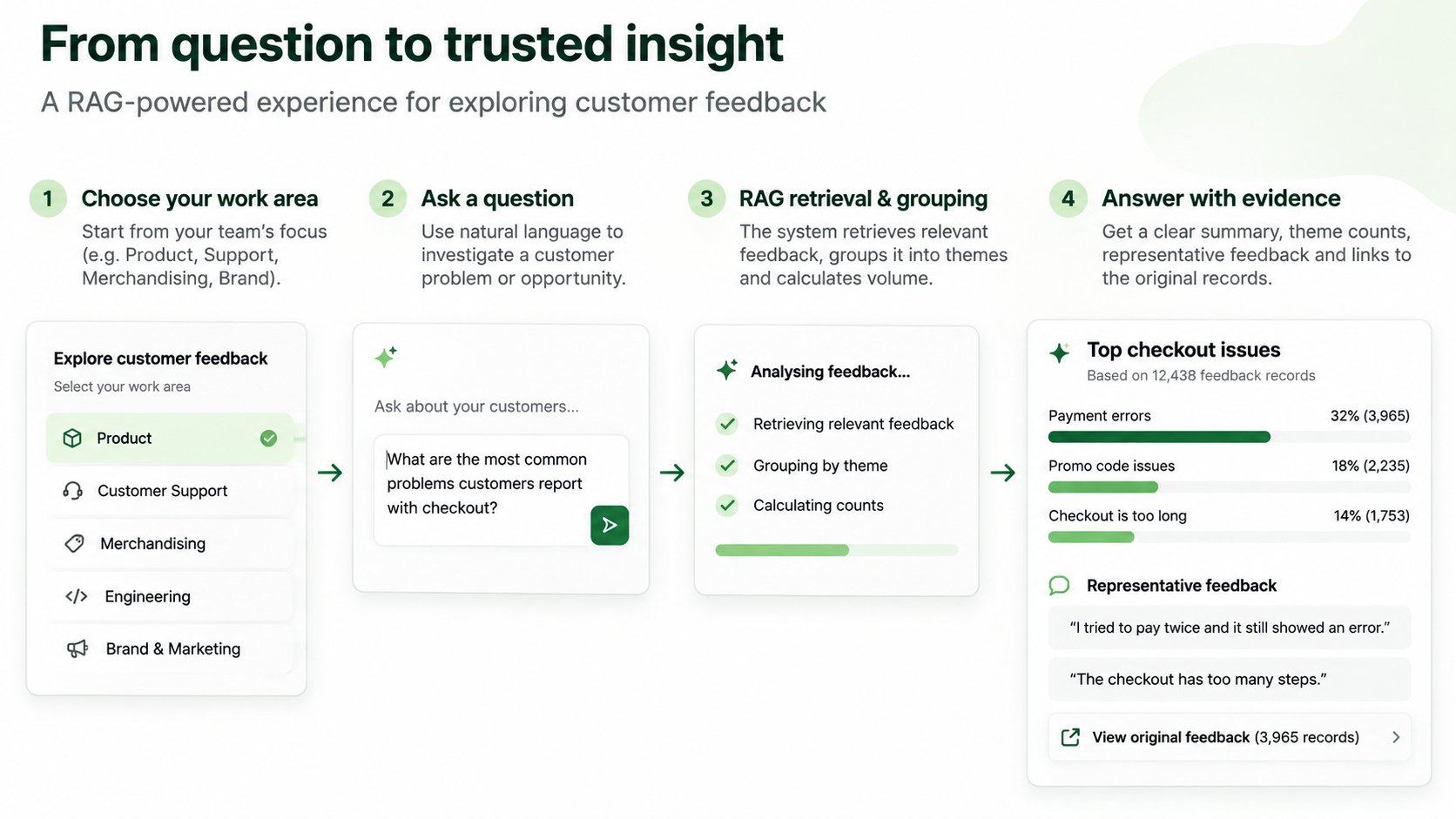
I designed the experience so stakeholders could begin with a natural-language question rather than navigating datasets or predefined reports.
The system used underlying models to retrieve relevant customer feedback and identify patterns.
2. Combine aggregated findings with representative examples
Showing individual feedback records wasn't sufficient to communicate the scale of a problem.
We designed the experience to group relevant feedback, display total counts and surface representative customer examples.
This helped users understand both how frequently an issue appeared and what customers were actually saying.
3. Make every insight traceable to its source
AI-generated answers needed to be verifiable.
I designed and implemented UX flows that allowed stakeholders to follow evidence links back to the original data source and inspect the underlying feedback themselves.
This was a deliberate product decision to support transparency, trust and independent verification.
4. Make complex data accessible across departments
Customer support, digital product, merchandising, engineering and brand teams had different questions about customer experience.
I designed a shared conversational experience that allowed these teams to investigate customer feedback without requiring specialist data-analysis skills.
What we shipped
We launched a RAG-powered customer intelligence product that enabled stakeholders to:
Ask natural-language questions about customer feedback.
Retrieve and group relevant feedback using underlying models.
See aggregated counts and representative examples.
Follow evidence links to inspect the original source data.
The experience connected conversational AI with structured presentation of customer evidence.
Outcomes & impact
The launch introduced a shared way for business teams to investigate customer feedback and explore recurring customer problems.
By combining aggregated findings, representative examples and direct links to original data, the product supported more transparent, evidence-informed decision-making.