
Planning a roadmap for a complex digital product can be challenging. Travel websites, marketplaces and rental platforms have many moving parts, with several teams competing for the same development time.
I’ve been there. As Product Owner for SEO at Lastminute travel group, I focused on organic and paid search across five high-volume websites. Everyone wanted a piece of the product development time, and deciding what to prioritise meant understanding their requests, the dependencies and the potential impact.
I also consulted for Rentumo, a rental search service helping thousands of people find a new home. Its ambition to offer comprehensive rental coverage brought similar questions: how do you balance acquisition, conversion, data quality and product improvements with limited resources?
In this article, I share how I approach those decisions by understanding stakeholders’ needs, connecting initiatives to business objectives and building a roadmap that leaves room for maintenance, learning and experimentation.
Where do you start with a digital product roadmap?
A product roadmap sets out the direction of a product, the outcomes you want to achieve and the main initiatives you expect to work on.
For a complex website or digital service, it helps teams see how their work contributes to the wider product. It also gives you a basis for discussing what comes first and what needs to wait.
Before planning the work, it helps to understand why prioritisation becomes difficult.
Feature complexity and dependencies
Features such as ranking algorithms, popularity scores and search results are often connected.
Adjusting a ranking algorithm, adding new properties or introducing a travel package can change which results users see and how they interact with them. A popularity score also depends on the quality of the data behind it.
Larger releases need appropriate testing and coordination between engineering, data, UX and marketing. These dependencies should be visible in the roadmap.
Competing priorities
Your SEO team may need automated title tags. Your conversion specialist may want to test a new landing page. A country team may want to add hotels in a priority destination, such as London.
What do you start with?
You need to understand the problem behind each request, its potential contribution to business goals and what it will take to deliver.
There is also a balance between immediate improvements and foundational work. Better data collection, for example, may be needed to provide more accurate results on the front end.
Market and competitive pressure
Travel and hospitality products operate in competitive markets. Looking at Booking.com or Expedia can help you understand what customers may expect, but your own users and product context should inform your decisions.
Spend time reviewing how people use your product. I find session recordings and heatmaps useful for noticing patterns and deciding what to investigate further.
Scalability and performance
Some decisions benefit from A/B testing. For example, you might compare the effect of sorting results by “recommended”, “trending” or “newest”.
Other changes may begin with usability testing or a straightforward fix. If mobile users have to scroll back and forth to reach the filters, investigate the difficulty and improve access.
Choose a validation method that fits the question, the traffic available and the risk of the change.
Localisation and regional differences
Even when websites look identical across the US, Australia and the UK, users may behave differently.
Pricing sensitivity, booking habits and expectations can vary. Look for differences in the data and investigate them through customer feedback and behavioural research before deciding that each market needs the same solution.
Local requirements can also affect what you can launch and when.
Technical debt and maintenance
I remember working with legacy products at D-EDGE when we decided to move towards React.
Technology changes need space in the roadmap. Discuss what they will enable and how the transition affects other work. Maintenance, learning and improvements to the platform all require capacity alongside new features.
Customer expectations and feedback
Customer feedback can point in different directions. Some users prefer sorting by price; others want popularity or relevance.
Look at who is asking, what they are trying to do and how often the problem occurs. You may need research or testing before choosing a solution.
1. Understand departments and key stakeholders
Start by understanding how the teams involved operate and how they have submitted product requests in the past.
Have their requests been prioritised? On what basis? Do they know what information to provide, and can they see what happened to their suggestions?
I would ask each team about its goals, recurring customer problems, current requests and dependencies.
This helps you understand the product and the process around it. If requests arrive through several channels with different definitions of urgency, agree a consistent way to capture and discuss them.
2. Define your vision and objectives
Before getting into individual initiatives, clarify the direction of the product.
For a rental search service, an example vision could be:
To be the most trusted and efficient rental search agent on the market.
Then identify the outcomes that would show progress towards that vision. Are you focusing on acquisition, trial starts, paid conversion, retention or operational efficiency?
As it comes to subscription products, some targets could include:
Increase the visitor-to-trial conversion rate by 30% over six months.
Improve the trial-to-paid conversion rate by 20% over six months.
Reduce subscription churn by 15% over six months.
Reach the top 10 for 15 relevant, high-intent rental keywords in the next quarter.
Reduce acquisition cost by 15% while maintaining customer quality.
Define the starting point, timeframe and measurement method for each target. For example, a trial conversion rate moving from 10% to 12% is a 20% relative increase.
Search rankings and acquisition costs can be useful measures, but connect them to the wider business outcome and the customer journey, channel journey, website and product. Reducing ad spend alone does not tell you whether acquisition became more efficient.
3. Use company OKRs to guide roadmap decisions
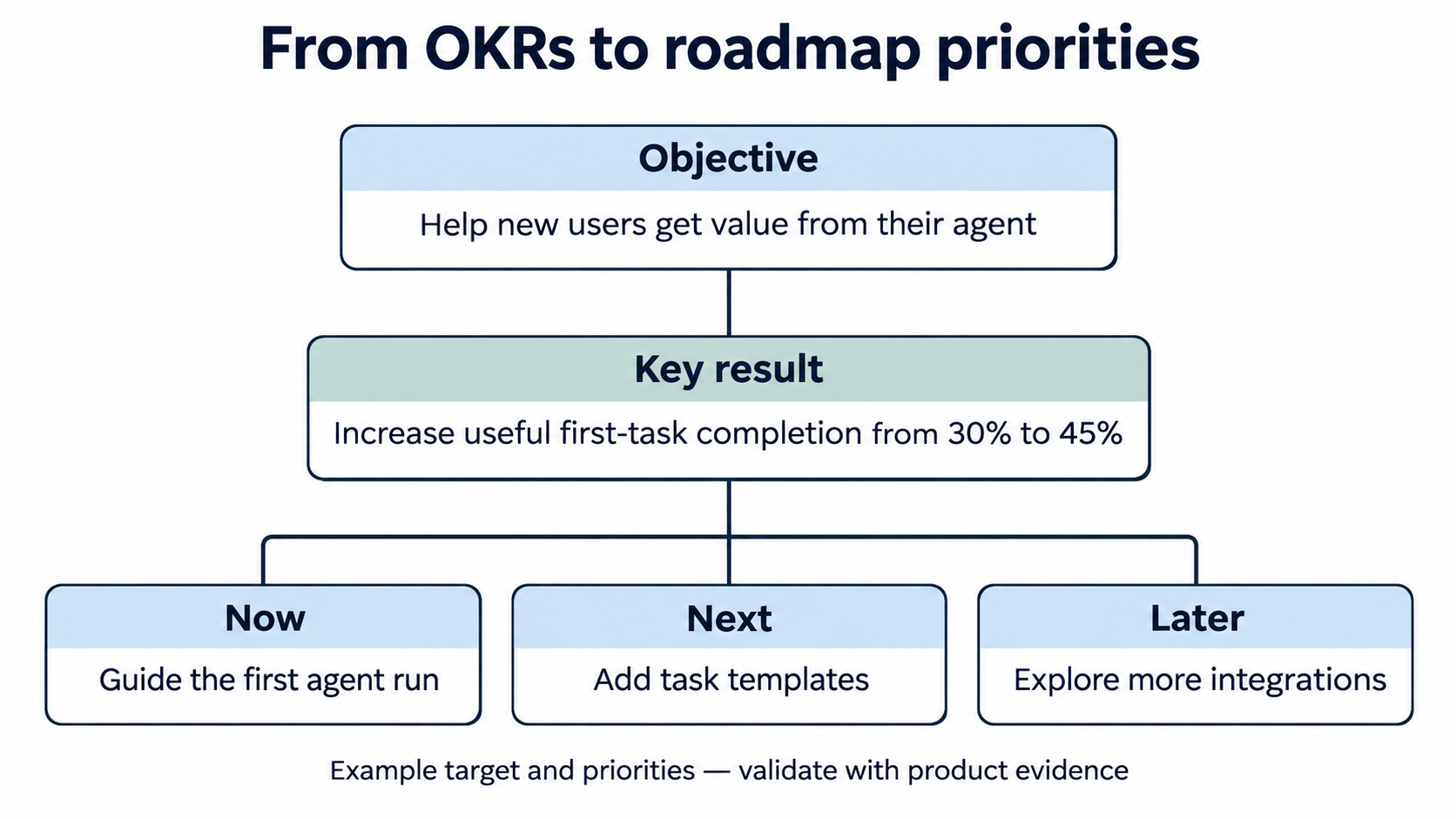
Company OKRs—objectives and key results simply give teams a shared basis for discussing priorities.
For example, the company may want to increase revenue by 25% over the next year. Product work could contribute through more trial starts, better trial-to-paid conversion or improved retention.
The right contribution depends on where the opportunity is.
If users abandon registration, improving sign-up may be a priority. If they register but never find relevant properties, the team needs to look further into the product experience.
Be precise about the connection. A simpler sign-up process may improve visitor-to-trial conversion; it will not necessarily resolve the reasons trial users fail to become paying customers.
Leave room for maintenance and smaller improvements, but keep checking whether the work supports the objectives. It is easy to fill a quarter with manageable tasks and still leave the main problem unresolved.
4. Break the work into connected workstreams
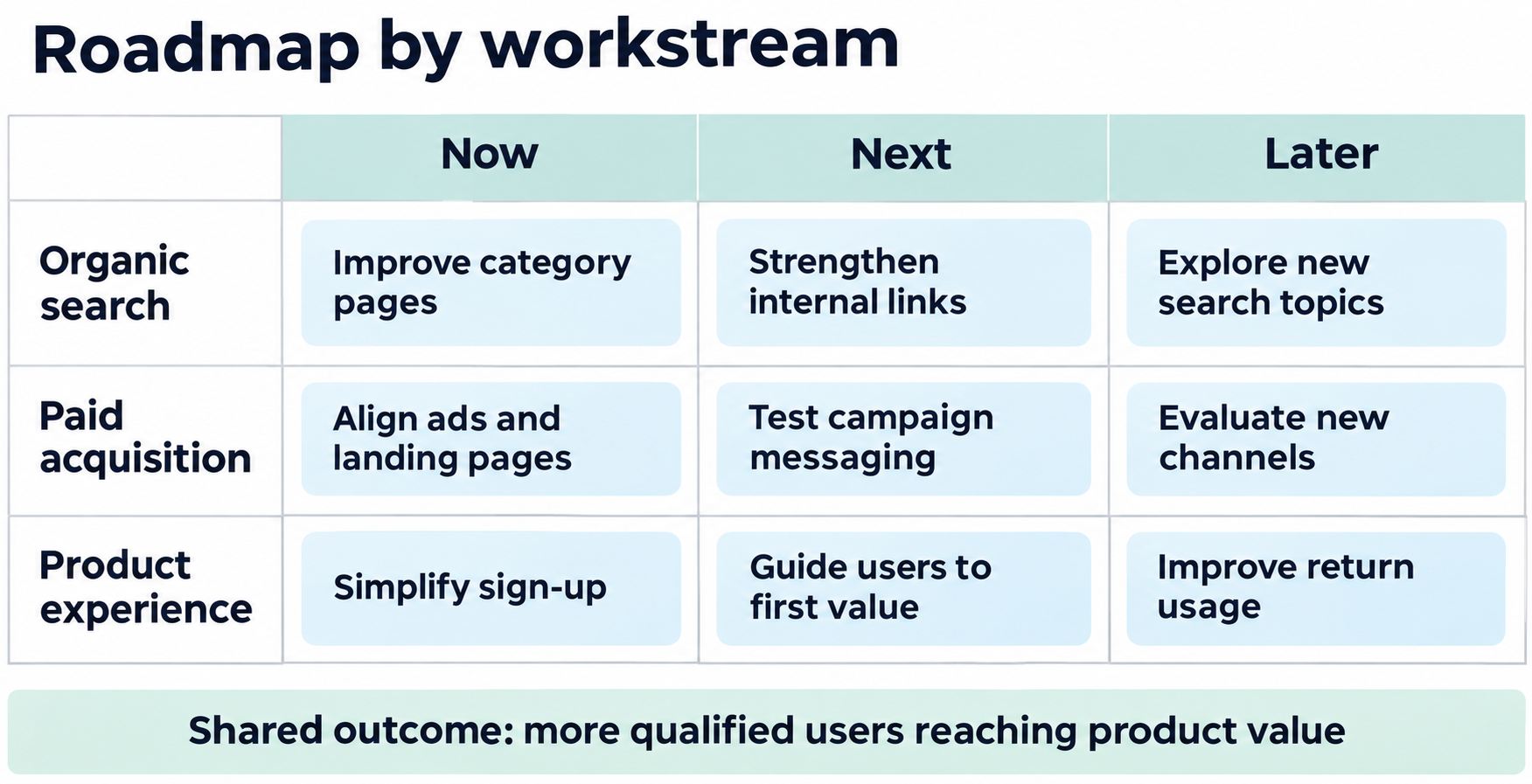
On websites with many listings, pages and data points, workstreams can help organise responsibilities and dependencies.
The examples below show how different areas might contribute to the roadmap. You would choose the relevant work after reviewing your own evidence.
Conversion rate optimisation and trial experience
Combine analytics with customer feedback and behavioural research to understand where people struggle.
Potential initiatives include:
Improving landing-page messaging, CTAs and relevant trust signals.
Simplifying checkout or trial registration.
Making filters easier to use on mobile.
Improving page performance.
Clarifying what users receive during the trial.
Helping trial users reach a useful result sooner.
An illustrative target might be increasing a landing-page conversion rate from 3% to 5% in a quarter. Whether that is realistic depends on the baseline, audience and problems identified.
SEO and organic acquisition
For a rental or travel product, this could involve category pages, listing pages, internal links, structured data and useful content around searchers’ questions.
For example, rental tips, market information or comparison guides may support discovery. Prioritise them according to relevance and the role they play in the customer journey.
You might set a target for qualified organic traffic, then track how those visits contribute to trial starts, enquiries or bookings.
Performance marketing
Paid acquisition work might include Google Ads or Meta campaigns, pages tailored to specific search intent and follow-up for people who left before completing a relevant action.
Review the whole path. If the ad promises something the page or product does not deliver, campaign adjustments alone may have limited impact.
An example target could be reducing customer acquisition cost by 15% over three months while maintaining customer quality.
Data collection and quality
For a listing-based product driven by data, data coverage and freshness affect what users can find.
Work might include connecting third-party data, improving update processes or making more relevant information available to the front end.
Competitor pricing insights can also be useful where reliable, permitted sources are available. Start with the decision the data will support before investing in collection or automation.
A delivery milestone such as “automated updates implemented by the end of Q2” should sit alongside a quality measure, such as fewer outdated listings or more reliable availability.
Platform maintenance and expansion
Include performance improvements, security updates, bug fixes and technical debt.
Larger opportunities may involve flexible pricing, dynamic availability, personalised recommendations, a new market or an assistant for customer enquiries.
Each needs a clear reason for inclusion. Estimate the dependencies and capacity required before adding it to a delivery plan.
Retention may involve several workstreams. Automated email follow-ups can help in some situations, but users also need an experience worth returning to.
5. Prioritise the work
An impact-versus-effort matrix is a useful starting point when you are managing many requests.
Add your confidence in the evidence and any dependencies. An initiative can sound valuable while still needing investigation. I would avoid assigning “high impact” to these automatically. The priority depends on what you know about the product.
Also watch the temptation to keep completing easy tasks. Small improvements can add up, but they can also distract from a larger constraint that needs attention.
6. Build a timeline and execution plan
Choose a planning format that works for your team.
A quarterly roadmap can help when you need broad planning windows and understand the main dependencies. A Now, Next, Later roadmap can be useful when the direction is clear but solutions and timing still need investigation.
For a quarterly plan, you could use similar themes across the year: improve the existing journey first, address data and acquisition opportunities next, then consider expansion as the evidence and capacity allow.
Break larger initiatives into manageable epics and user stories. Keep the intended outcome visible so the team can make sensible decisions when the scope changes.
7. Review progress and keep learning
Review delivery progress regularly and give outcome measures enough time to become meaningful.
A fortnightly check-in can help surface blockers, new feedback and decisions that need attention. Broader reviews can assess whether the roadmap priorities still make sense.
Keep a product idea backlog, but ask what a new request would displace before bringing it into the current plan.
Use tools such as Notion, Jira, Trello or Asana to keep the work visible. I recommend agreeing the goals and decision process first, then choosing how to organise them in the tool.
Keep returning to the questions that matter for your product:
Are people finding what they came for?
Where do they struggle?
What helps them experience value? Don´t skip this part as it should drive all your roadmap.
Which improvements contribute to paid conversion, bookings or retention?
What have we learned that should change the priorities?
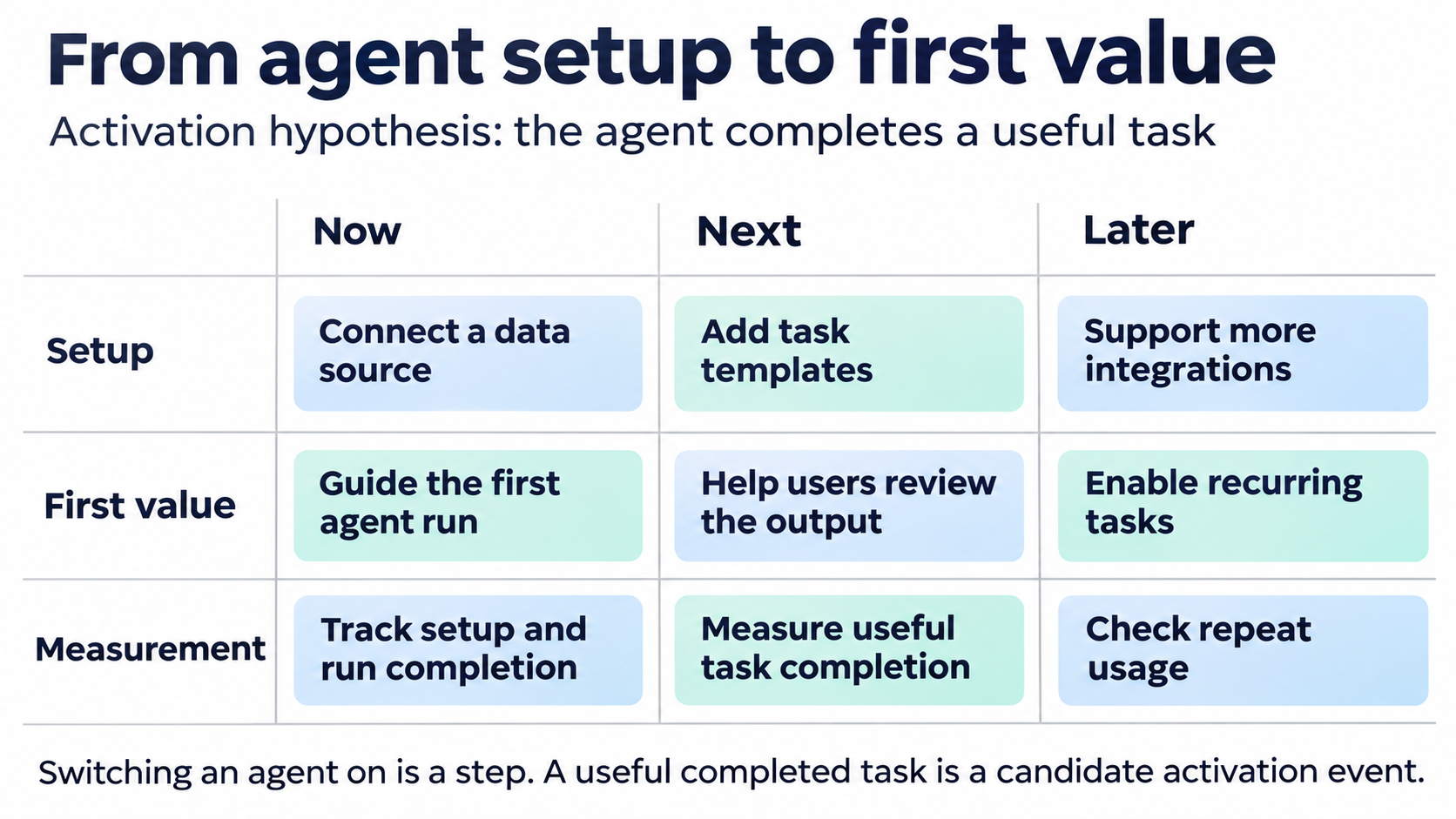
For a trial product, map the moments when users first experience value and investigate what prevents them from reaching those moments.
Bringing the roadmap together
The most useful input often comes from combining your quantitative data, customer feedback, behavioural research and the knowledge of your internal teams.
That combination helps you understand why a request matters, what needs further investigation and which dependencies affect the order of the work.
My advice is to take the time to establish that shared understanding. It makes prioritisation easier to explain and gives teams a clearer connection between their daily work, the customer experience and the business goals.
If you need help reviewing competing priorities or turning journey findings into a practical roadmap, you can read more about my fractional product management work.