

Collect feedback with a decision in mind
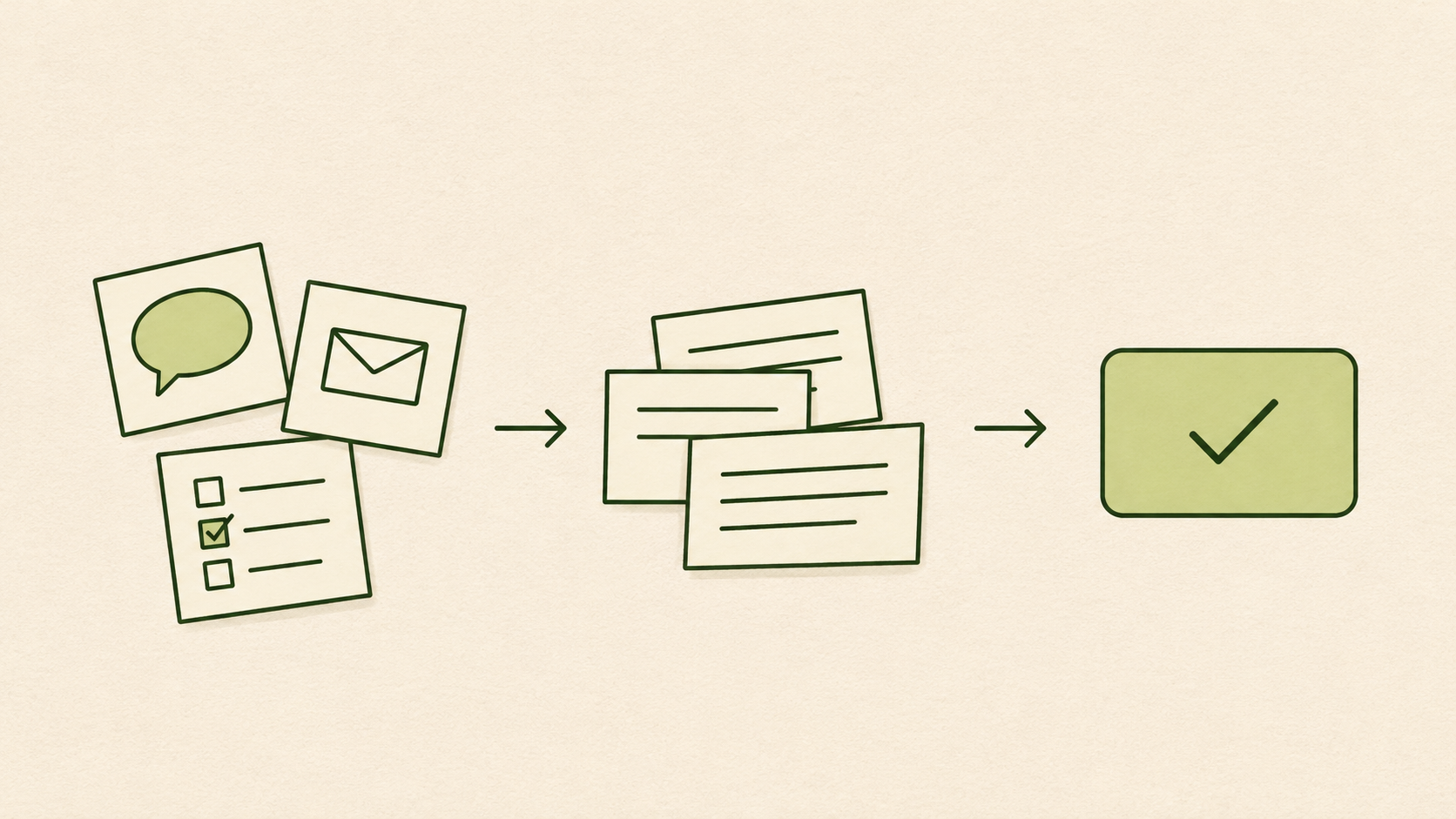
Customer feedback comes from everywhere: a support ticket, a cancellation email, a survey response or a conversation with an account manager. Collecting it is relatively easy. Understanding what it means for your product takes more work.
I find it useful to start with what we need to understand. Are new customers struggling to get started? Are people paying for a product but barely using it? Is a feature request pointing to a problem we have not understood yet?
That gives the research a purpose and helps us decide who to hear from. A generic survey sent to everyone may collect plenty of opinions while leaving the important question unanswered.
Surveys are one input into continuous discovery. Alongside interviews, support conversations, observation and behavioural data, they help us spot patterns and find people to speak with.
Hear from customers with different experiences
Your happiest customers have something to teach you. So do those who struggled, stopped using the product or chose another option. I would choose the groups around the question we are investigating, rather than trying to survey every segment at once.
Customer groupWhat I would try to understandRecently joinedWhat brought them here, what they expected and what happened when they got startedActive and successfulWhich tasks the product helps them complete and where its value comes fromStruggling to get startedWhat they tried, where they became stuck and what they did nextPaying but less activeWhether their need changed, they found a workaround or they have not reached useful valueCancelling or already leftWhat led to the decision and how they now solve the problemEvaluated but did not buyWhich requirements, concerns or alternatives influenced the decision
Subscription plan, role and use case add useful context. Someone using a product every day may have very different needs from an occasional user. A request from an administrator may not represent the experience of the people doing the work.
Keep those differences visible when reviewing the responses. Ten similar comments tell you less if you do not know who made them or what they were trying to achieve.
Start with the conversations your team already has
Before creating another form, look at what customers have already told your team.
Support tickets can reveal repeated questions. Sales conversations can show what people expected before buying. Account managers may know which tasks need extra explanation or a workaround. Cancellation messages can add context to a drop in usage.
Involve the people who have those conversations. Ask what they keep hearing and request concrete examples. Their interpretation is useful, but the original customer wording helps us check whether we are drawing the same conclusion.
My experience has taught me that customers sometimes do not know a feature exists, even after launch communication. A request for a new capability may therefore lead us to investigate discoverability, naming or onboarding before building anything.
That is why I would not turn every request straight into a roadmap item.
Choose the method around what you need to learn
For a survey, keep the questions focused and easy to answer. You do not need to include every question you might ask in an interview.
For example, if I wanted to investigate an onboarding task, I might ask:
What were you trying to achieve when you first used the product?
What, if anything, made that difficult?
How did you deal with it?
Then I would invite respondents to a follow-up conversation, with their permission. The aim is to learn enough to investigate, rather than make the form do all the work.
Ask about experiences people can describe
“How can we improve?” can produce interesting suggestions, but it gives people little direction. I prefer to ask about something that actually happened.
Instead of starting with…Try…What feature should we build next?Tell me about the last time you tried to complete this task.Would you use this feature?How do you handle this today?Do you understand this feature?What would you expect to happen here?What would make you use the product more?When did you last need it, and what happened?Why do you love our product?What has been most useful, and in what situation?
Suggestions still matter. When someone asks for a feature, I want to understand the task behind it, the difficulty they ran into and the consequences. Several people can ask for the same feature for different reasons.
For customers who cancel, a useful starting point is: “What led you to decide to cancel?” Follow with questions about what happened beforehand and how they will handle the task now. Keep the conversation open enough for reasons you did not anticipate.
Keep the context with the feedback
A spreadsheet or shared document can be enough to start. What matters is being able to trace a finding back to its source. For each item, record:
the customer’s words
the date and source
the relevant segment
the task or journey stage
any follow-up needed
Keep your interpretation in a separate field. For example, “I could not find the export option” is the reported experience. “We need to redesign navigation” is a proposed response. We need more evidence before treating them as the same thing.
As patterns emerge, group related problems without losing the differences between customers. Note how you recruited respondents too, because people who answer a survey may have different experiences from those who do not.
Close the loop and decide what to investigate
Thank people for their time and explain the next step where you can. Listening does not mean promising to build every suggestion.
Before prioritising a change, I would ask: who experiences this, how does it affect their task, what else supports the finding and what remains uncertain?
That is where feedback connects with behavioural data. Customers can explain their expectations and experiences. Product and website data can help us see where those experiences sit within a wider pattern.
The next step is to bring those sources together and examine the journey from discovery to useful value.
If you are hearing from new, struggling or cancelling customers and want to turn that into activation and retention decisions, you can read more about my Product Growth & Monetisation work.